
Updated: October 2026 | Author: Muhammad Khubaib Zia | Website: M Khubaib Zia
Quick answer
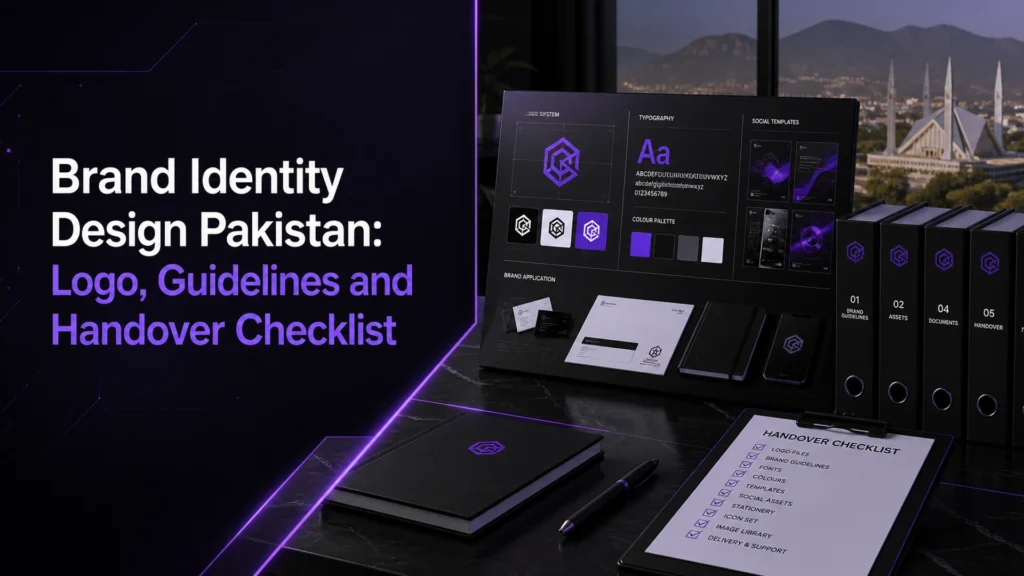
A brand identity design Pakistan project should deliver more than one logo image. Agree the brand brief, primary and secondary marks, responsive versions, colour values, typography, spacing, minimum sizes, background rules, social assets, editable source files, export formats, font and stock licences, ownership terms and an organised handover. The final system should be practical for web, print and daily marketing.
A logo may look strong in a presentation yet fail when it is placed on a small profile image, invoice, website header or monochrome document. Brand identity work solves this by creating a consistent system with rules, files and examples, not by producing one decorative mark.
This brand identity design Pakistan guide helps businesses prepare a clearer brief and test delivery. Review the current design and digital services and project portfolio when defining scope. Neither a fixed price nor a universal number of concepts can replace agreed applications and acceptance checks.
What should a brand identity design brief define?
Define the audience, offer, market position, personality, competitors, practical applications and constraints. Include the exact legal or trading name, spelling, languages and any tagline that is approved. Explain where the identity will appear in the first year.
However, avoid solving the design in the brief. Describe the problem and decision criteria instead of requesting a copied symbol or fashionable effect. For example, competitor examples can explain differentiation without becoming instructions to reproduce another business’s work.
| Brief item | Useful detail | Why it matters |
|---|---|---|
| Audience | Buyer type, location and context | Shapes tone and clarity |
| Position | Affordable, premium, specialist or broad | Guides visual choices |
| Applications | Website, signage, social, packaging, documents | Determines logo variants |
| Languages | English, Urdu or bilingual needs | Affects typography |
| Constraints | Colours, legal name and existing assets | Prevents unusable concepts |
Which logo versions belong in a brand identity system?
A practical identity normally includes a primary mark, a simplified or compact version and a standalone symbol where the concept supports it. Each version should work on light and dark backgrounds and remain clear at the intended minimum size.
Next, ask which version belongs in the website header, profile image, print document and small digital icon. A system does not need unnecessary variations. Instead, it needs predictable uses, so staff can choose an approved mark without requesting another export for each routine task.
- Primary horizontal or main lockup.
- Compact, stacked or responsive alternative.
- Symbol or monogram when appropriate.
- Full colour, black, white and single-colour exports.
- Clear-space and minimum-size guidance.
- Approved and prohibited background use.
How should brand identity guidelines document colour and type?
A brand identity design Pakistan colour specification should identify the intended screen and print uses. Record HEX and RGB for screens, then add print values when print is in scope. However, stock and production affect appearance, so request a proof for critical applications rather than treating a screen preview as a guarantee.
Also document typefaces, weights, hierarchy and licences. A font in a mock-up may not be licensed for the client’s intended website or app use. Therefore, confirm the relevant terms and provide an approved substitute where office documents must remain editable across different devices.
What makes visual identity guidelines practical for staff?
Practical guidelines answer production questions quickly. For example, show spacing, alignment, backgrounds, type hierarchy and colour combinations in actual layouts. Then illustrate misuse, such as stretching a mark or placing it over a low-contrast photograph, so suppliers can recognise problems before delivery.
However, the guide should match the organisation. A small business may need a concise document, while a multi-team brand may need templates and a review process. More pages do not automatically improve the system. Instead, check whether staff can find the answer to a routine production question.
Digital applications
Include website header behaviour, favicons, profile images, social post structure and presentation covers where they are in scope.
Print applications
Include business cards, letterheads, invoices, signage or packaging only when the project covers them, with production-ready specifications.
Which source and export files complete a brand identity handover?
A brand identity design Pakistan handover needs editable source files and clearly organised exports. Sort them by logo version, colour and background. Common formats include SVG, PDF, EPS, PNG and JPEG, depending on use. Also confirm the software version and whether linked assets, effects and fonts remain available for authorised changes.
A large JPEG is not an editable vector source. Therefore, open several delivered files, check transparency and place the mark on light and dark backgrounds. Also inspect filenames: they should identify the approved version and use without requiring staff to open every asset.
| File | Typical use | Check |
|---|---|---|
| SVG | Web and scalable digital use | Clean viewBox and correct colour |
| PDF or EPS | Print and vendor handoff | Vector content and fonts |
| PNG | Transparent digital use | Correct padding and resolution |
| JPEG | Preview or flat background | No transparency expected |
| Editable source | Future authorised changes | Linked assets and fonts included or documented |
Clarify ownership, fonts and third-party licences
The agreement should state what rights transfer after payment, what portfolio rights remain, and which third-party items are licensed separately. Fonts, stock images, mock-ups, icons and templates may have their own terms. Do not assume that receiving a file transfers every underlying licence.
Next, keep purchase receipts, licence links and approval records with the handover. If a stock symbol forms part of a proposed logo, ask about restrictions before adopting it. However, do not infer exclusive rights merely from receiving an editable file; clarify uncertainty with the supplier or an appropriate adviser.
Run a final handover and implementation review
Finally, use a checklist and a handover note to confirm the approved concept, spelling, colour values and font access. Check the agreed logo versions, templates and source files too. Then test real applications before closing the project, so missing delivery items become specific correction requests.
Also assign an internal brand owner who can answer suppliers and approve exceptions. Otherwise, teams may use unofficial colours or old files because nobody knows which folder is current. Mark obsolete versions clearly, then keep the approved package in a controlled location with read-only masters.
Before final approval, plan the first implementation tasks. Replace website assets, social profiles, document templates and sales materials in a controlled order. Then check real devices and printed proofs where appropriate. Give each application an owner and deadline so the launch does not depend on memory alone.
Connect the identity handover to ongoing marketing only after teams receive the approved assets. The social media management scope guide helps distinguish recurring templates from identity design. Meanwhile, the website proposal checklist helps assign responsibility for implementing the new marks.
For scalable web assets, the W3C SVG specification explains the vector format. However, receiving an SVG does not prove the artwork will fit every header. Test the actual export in the intended layout, including its padding, colours and small-size appearance, before accepting it.
Frequently asked questions
Request suitable vector source files, web and print exports, colour variants, transparent versions and a clear folder structure based on the agreed scope.
No. They need enough detail for consistent real-world use. A concise guide can be effective when it answers the organisation’s common production questions.
Ownership depends on the written agreement, payment and third-party licences. Confirm transfer terms and retained portfolio rights before work begins.
Not necessarily. Many fonts require the client to obtain a licence. The handover should name the font, source, licence responsibility and approved substitutes.
Not automatically. Stock libraries may restrict trademark registration or exclusive use, so check the relevant licence before approval.
Test it at small sizes, on light and dark backgrounds, in monochrome, on the website, social profiles and priority print applications.
Final thoughts
Before approving a brand identity design Pakistan handover, test the delivery package on another device. Open vector files and check transparent PNG exports. Compare colour values with the guide, then place the marks into a website header, social profile and invoice.
Next, check small-size clarity and both light and dark backgrounds. Ask for corrections to missing exports, broken asset links or unexplained third-party files. Keep a read-only master archive and separate working copies, with an approved version date to prevent accidental reuse of obsolete marks.
If Urdu or bilingual typography is included, verify spelling, reading direction and spacing with a competent reviewer. Document the font source and relevant licence information. These checks make the system usable by staff and suppliers without requiring them to recreate files or guess approved colours.
Brand identity design Pakistan should leave the business with a usable visual system, not a single attractive preview. A clear brief, responsive logo family, documented type and colour, licensed assets, editable files and verified handover protect the investment.
For a scoped proposal, share the business name, audience, applications, languages, timeline and existing assets through the contact page. Explain the practical uses first, so the brand identity design Pakistan brief defines a system that the team can implement rather than merely admire.