
Updated: August 2026 | Author: Muhammad Khubaib Zia | Website: M Khubaib Zia
Quick answer
A brand identity design Pakistan project should deliver more than one logo image. Agree the brand brief, primary and secondary marks, responsive versions, colour values, typography, spacing, minimum sizes, background rules, social assets, editable source files, export formats, font and stock licences, ownership terms and an organised handover. The final system should be practical for web, print and daily marketing.
A logo may look strong in a presentation yet fail when it is placed on a small profile image, invoice, website header or monochrome document. Brand identity work solves this by creating a consistent system with rules, files and examples, not by producing one decorative mark.
This guide supports branding identity services and graphic design services in Islamabad. It helps Pakistani businesses write a better brief and verify delivery without inventing a standard price or fixed number of concepts.
Write the business brief before requesting concepts
Define the audience, offer, market position, personality, competitors, practical applications and constraints. Include the exact legal or trading name, spelling, languages and any tagline that is approved. Explain where the identity will appear in the first year.
Avoid solving the design in the brief. Describe the problem and decision criteria rather than requesting a copied symbol or a fashionable effect. Share competitor examples to explain differentiation, not to reproduce their work.
| Brief item | Useful detail | Why it matters |
|---|---|---|
| Audience | Buyer type, location and context | Shapes tone and clarity |
| Position | Affordable, premium, specialist or broad | Guides visual choices |
| Applications | Website, signage, social, packaging, documents | Determines logo variants |
| Languages | English, Urdu or bilingual needs | Affects typography |
| Constraints | Colours, legal name and existing assets | Prevents unusable concepts |
Expect a logo system, not one file
A practical identity normally includes a primary mark, a simplified or compact version and a standalone symbol where the concept supports it. Each version should work on light and dark backgrounds and remain clear at the intended minimum size.
Ask the designer to explain which version belongs in the website header, profile image, print document and small digital icon. A system does not need unnecessary variations, but it does need predictable use.
- Primary horizontal or main lockup.
- Compact, stacked or responsive alternative.
- Symbol or monogram when appropriate.
- Full colour, black, white and single-colour exports.
- Clear-space and minimum-size guidance.
- Approved and prohibited background use.
Document colour and typography accurately
Record colour values for relevant environments, such as HEX and RGB for screens plus print values when print is in scope. Printed colour can vary by stock, process and vendor, so request a proof for critical applications instead of treating a screen preview as a guarantee.
List the typefaces, weights, hierarchy and licences. A font visible in a mock-up may not be licensed for the client, website or app. Provide approved substitutes where cross-platform office documents must remain editable.
Create guidelines people will actually use
Guidelines should answer common production questions quickly. Show spacing, alignment, backgrounds, typography hierarchy, colour combinations, image direction and basic examples. Include misuse examples such as stretching, recolouring, adding effects or placing the logo on a low-contrast photograph.
The document should match the size of the organisation. A small business may need a concise practical guide, while a multi-team brand may need deeper rules, templates and governance. More pages do not automatically make the system better.
Digital applications
Include website header behaviour, favicons, profile images, social post structure and presentation covers where they are in scope.
Print applications
Include business cards, letterheads, invoices, signage or packaging only when the project covers them, with production-ready specifications.
Request the right source and export files
Receive editable vector source files and standard exports organised by logo version, colour and background. Common deliverables may include SVG, PDF, EPS, PNG and JPEG depending on the use case. Confirm which software version was used and whether effects or fonts remain editable.
Do not treat a large JPEG as a source file. Open several delivered files, check transparency, zoom vector artwork and place the logo on light and dark backgrounds. File names should identify the variant without opening every asset.
| File | Typical use | Check |
|---|---|---|
| SVG | Web and scalable digital use | Clean viewBox and correct colour |
| PDF or EPS | Print and vendor handoff | Vector content and fonts |
| PNG | Transparent digital use | Correct padding and resolution |
| JPEG | Preview or flat background | No transparency expected |
| Editable source | Future authorised changes | Linked assets and fonts included or documented |
Clarify ownership, fonts and third-party licences
The agreement should state what rights transfer after payment, what portfolio rights remain, and which third-party items are licensed separately. Fonts, stock images, mock-ups, icons and templates may have their own terms. Do not assume that receiving a file transfers every underlying licence.
Keep purchase receipts, licence links and approval records with the handover. If a mark contains a symbol from a stock library, confirm whether exclusive trademark use is permitted before adopting it as a core logo.
Run a final handover and implementation review
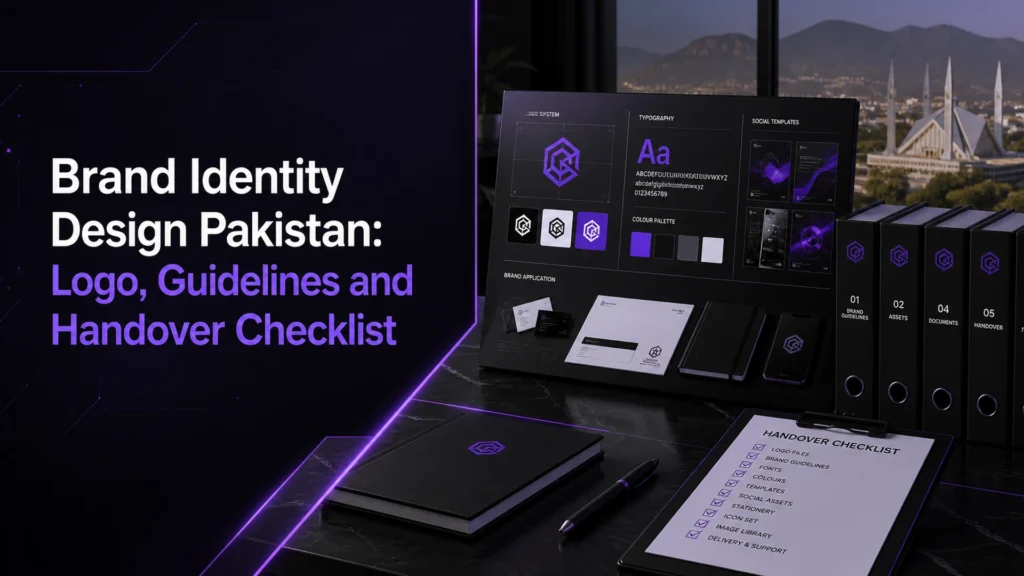
Use a checklist and a recorded meeting or handover note. Confirm the final approved concept, spelling, colour values, font access, logo variants, templates, source files and backup location. Test the identity in real applications before closing the project.
Assign one internal brand owner who can answer suppliers and approve exceptions. Without ownership, teams create unofficial colour values, stretch marks or use old files because nobody knows which folder is current. Mark obsolete versions clearly and keep the approved package in a controlled shared location with read-only master files.
Plan the first implementation tasks before final approval. Replace website assets, profile images, document templates and sales materials in a controlled order, then check them on real devices and printed proofs where needed. A brand launch is easier to review when each application has an owner, deadline and approval record.
Connect the new identity to the digital marketing service and the contact page only after web and campaign teams receive the correct assets. The existing article on social media management scope can help define which branded templates belong in ongoing marketing rather than the identity project.
Frequently asked questions
What files should a logo designer deliver?
Request suitable vector source files, web and print exports, colour variants, transparent versions and a clear folder structure based on the agreed scope.
Do brand guidelines need many pages?
No. They need enough detail for consistent real-world use. A concise guide can be effective when it answers the organisation’s common production questions.
Who owns the final logo?
Ownership depends on the written agreement, payment and third-party licences. Confirm transfer terms and retained portfolio rights before work begins.
Are font files always included?
Not necessarily. Many fonts require the client to obtain a licence. The handover should name the font, source, licence responsibility and approved substitutes.
Can a stock icon become an exclusive logo?
Not automatically. Stock libraries may restrict trademark registration or exclusive use, so check the relevant licence before approval.
How should a brand identity be tested?
Test it at small sizes, on light and dark backgrounds, in monochrome, on the website, social profiles and priority print applications.
Final thoughts
Brand identity design Pakistan should leave the business with a usable visual system, not a single attractive preview. A clear brief, responsive logo family, documented type and colour, licensed assets, editable files and verified handover protect the investment.
For a scoped proposal, share the business name, audience, applications, languages, timeline and existing brand assets through the contact page.