
Updated: September 2026 | Author: Muhammad Khubaib Zia | Website: M Khubaib Zia
Quick answer
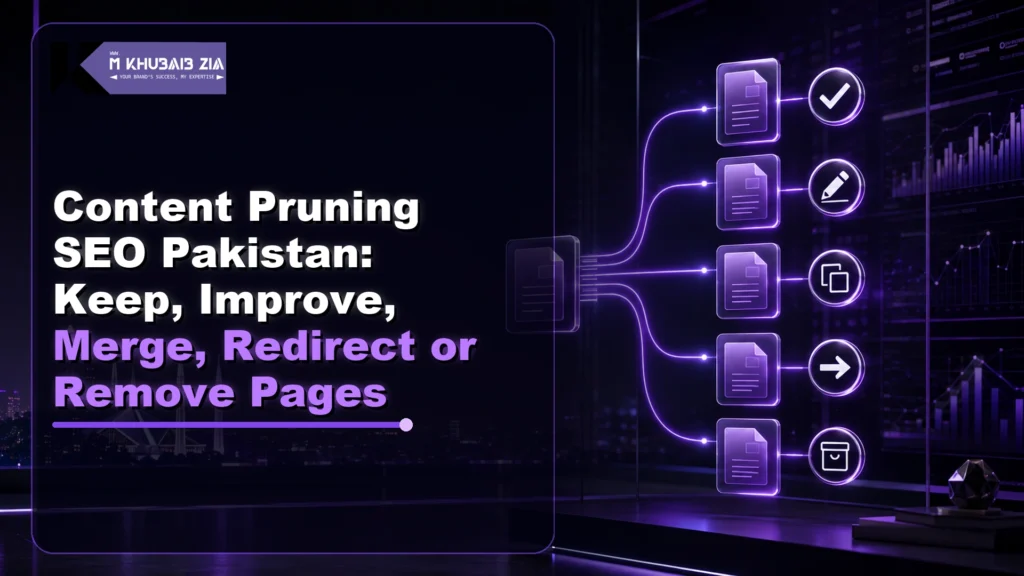
Content pruning SEO Pakistan means reviewing each URL and choosing keep, improve, merge, redirect, noindex or remove based on purpose, accuracy, demand, links, conversions and duplication. Preserve pages that help a real audience. Improve incomplete but valuable resources. Merge genuine overlap into the strongest destination. Use permanent redirects only when a close replacement exists, and return a clear not-found response when removal has no substitute.
Removing old pages can feel like a fast quality fix. It can also erase useful answers, inbound links and customer journeys when a team uses traffic alone as the decision rule. Therefore, a careful audit asks what each page does, whether it remains accurate and whether another URL serves the same intent better.
This guide supports the SEO and content services listed on the M Khubaib Zia services page. It follows current Google guidance and rejects the idea that mass deletion automatically makes a site fresh or more trusted.
What is content pruning SEO Pakistan?
It is a controlled page-level decision process, not a campaign to delete everything with low traffic.
Google’s people-first content guidance warns against adding or removing large amounts of content mainly to make a site appear fresh. Therefore, content pruning SEO Pakistan should start with user value and business purpose.
Next, build a complete URL inventory. Include published pages, posts, categories, landing pages, media URLs, old campaigns and known redirects. A page can receive little search traffic while still supporting customers, sales, compliance or internal navigation.
Which evidence should content pruning SEO Pakistan use?
Combine page purpose, accuracy, search demand, user behaviour, conversions, backlinks, internal links and technical status.
First, choose a review period that covers normal seasonality. Use Search Console, analytics, sales feedback, backlink data and a crawl where access exists. Then add a manual quality review because tools cannot decide whether advice remains safe or complete.
However, treat zero clicks carefully. A new page may not have enough time, a blocked page may serve logged-in users, and a low-volume service may carry high business value. Evidence informs the decision; it does not replace judgement.
| Signal | Question | Caution |
|---|---|---|
| Purpose | Does the page solve a real task? | Low traffic does not mean no value |
| Accuracy | Are facts, links and instructions current? | Changing topics need live sources |
| Overlap | Does another URL serve the same intent better? | Shared words do not prove duplication |
| Authority | Do useful sites or internal pages link here? | Preserve valuable references |
| Outcome | Does it support enquiries, trust or compliance? | Last-click data may undercount help |
| Technical state | Is it indexable and canonical? | Fix errors before judging content |
When should a page stay unchanged?
Keep a page when it remains accurate, useful, distinct and aligned with the site even if its traffic looks modest.
First, verify the page against current facts and business operations. Check links, media, calls to action and mobile rendering. If it serves a stable need and another page does not replace it, keep it in the inventory with a future review date.
Also, preserve legal, support and trust pages that meet a real requirement. Do not rewrite them for commercial keywords simply because a report shows little organic traffic. Their value often sits outside acquisition metrics.
When should content improve instead of disappear?
Improve a page when its intent remains valuable but the answer lacks depth, evidence, clarity, usability or a suitable next step.
First, identify the missing information rather than increasing length blindly. Add current sources, clearer headings, original examples, decision criteria, tables or FAQs only when they help. Remove outdated claims and repetitive filler.
The WordPress blog quality audit provides a wider editorial review. Therefore, compare the refreshed page with the current search task and the business service reality before changing its title or URL.
When should overlapping pages merge?
Merge pages when they answer the same primary task and one stronger combined resource can preserve the useful parts.
First, choose the destination based on relevance, quality, links, conversions and URL stability. Copy only unique, accurate value from the weaker page. Then edit the combined resource so it reads as one coherent answer rather than two pages pasted together.
Next, update internal links to the chosen destination. Use a permanent server-side redirect from the retired URL when the replacement closely matches. Google’s redirect guidance explains how permanent and temporary redirects signal different intentions.
How should content pruning SEO Pakistan use canonical tags?
Use a canonical to signal the preferred version of duplicate or very similar content, not to hide unrelated weak pages.
Google defines canonicalisation as selecting a representative URL among duplicate versions. Therefore, a canonical fits parameters, print versions or legitimate near-duplicates when users still need those URLs. It does not replace a redirect after a page has permanently moved.
Also, keep internal links and sitemaps aligned with the preferred URL. Conflicting signals make the intended representative harder to understand. Review rendered canonicals after templates, plugins or migrations change.
When does noindex make sense?
Use noindex when people or systems need the page but it should not appear in search results, and allow crawlers to see the directive.
Examples may include account utilities, internal search results or duplicate archives that remain useful on the site. However, confirm the page role and plugin settings first. Blocking the URL in robots.txt can prevent a crawler from reading its noindex directive.
Do not noindex a weak service page as a substitute for improving it. Decide whether the page deserves a distinct public role. The SEO audit checklist helps separate indexability problems from editorial quality.
When should a page return 404 or 410?
Return a clear not-found response when content has gone permanently and no close replacement can satisfy the same need.
First, remove the URL from internal links and the sitemap. Then ensure the server returns the intended status rather than a soft 404 page with a successful response. Offer useful navigation on the error page without redirecting every removed URL to the home page.
However, check backlinks, campaigns, emails and offline material before removal. A relevant alternative may justify a redirect. An unrelated destination frustrates users and sends a weak signal about the move.
How should a team handle seasonal and time-sensitive pages?
Separate expired details from enduring value, then update, archive or retire the page according to the continuing user task.
First, check whether people still need historical results, application instructions, event recaps or policy context. If the page retains value, label the date clearly and link to the current resource. Do not change the date without making a substantive update.
For a recurring annual topic, decide whether one evergreen URL or separate yearly pages best serves users. Therefore, base the structure on distinct information, not a desire to publish another near-duplicate.
How can teams protect links and conversions during pruning?
Record every source URL, destination, internal link, external reference and business action before making a destructive change.
First, export internal links and review valuable external links where reliable data exists. Map forms, calls, downloads, product actions and assisted journeys. Then select the decision that preserves the user task.
After launch, test redirects, canonicals, status codes, sitemaps, navigation and analytics. Watch support messages and conversion paths as well as search reports. A technical success can still create a poor customer journey.
What should happen after a content pruning SEO Pakistan change?
Validate the live response, update discovery signals and monitor user and search outcomes against the recorded reason.
First, crawl the changed URLs and their most important linking pages. Confirm final status codes, canonicals, headings, internal links and sitemap entries. Next, inspect mobile rendering and complete any critical form or purchase journey.
Then annotate the change date in reporting. Search crawling and indexing take time, and Google does not guarantee a specific outcome. Therefore, use Search Console, analytics and business feedback as evidence while avoiding daily conclusions from noisy data.
What should a content pruning decision log contain?
Record the URL, page purpose, evidence window, decision, destination, owner, launch date and validation result.
First, capture the reason in plain language. Add screenshots or exported metrics only when they help future reviewers. Next, require approval for removals, sitewide noindex changes and redirect batches. These actions can affect many entry points.
Finally, schedule a follow-up crawl and Search Console review. For a scoped audit, use the contact page and share the public URL list. Do not share administrator access or personal customer records in an initial message.
Frequently asked questions
Not automatically. Low traffic may reflect niche value, seasonality, technical issues or a useful non-search role.
Only when the home page genuinely replaces the same need, which is uncommon. Use a close relevant destination or a clear not-found response.
A redirect sends visitors to another URL. A canonical keeps a URL available while signalling a preferred duplicate version.
Robots.txt controls crawling. Use an appropriate noindex or removal process when the goal concerns search visibility.
Choose a schedule based on topic change, business risk and site size. Review time-sensitive pages more often than stable resources.
No. Merge only when they serve the same primary task. Keep both when each has a distinct useful intent.
Final Thoughts
Content pruning SEO Pakistan succeeds when every page receives a reasoned decision. Keep distinct useful content, improve incomplete answers, merge genuine overlap and use redirects only when the destination truly replaces the removed page.
Therefore, document evidence, protect links and verify the live result. A smaller site is not automatically better. A clearer site that preserves valuable user journeys is the real goal.